HOW TO
PLAY CATHEDRAL
CATHEDRAL takes moments to learn,
years to master. The rules are few which is one of it's main attractions
but as you will discover the possibilities are endless.
INTRODUCTION
CATHEDRAL is based on the
concept of a City surrounded by a wall. The board, divided into one
hundred squares (10x10) represents the site of the city enclosed by the
wall. The two sets of pieces, light (bright) and dark (brown) symbolize
the buildings and the two opposing factions struggling to gain power and
hence dictate the way the city will develop.
Then there is the
CATHEDRAL the focal point of the city, a spiritual haven a place of
sanctuary which mediates in the struggle and helps prevent one side from
becoming too powerful and thus allows the city to develop in an orderly
manner. But beware! There is still much to learn about cities and the
forces which shaped them. Who knows what secrets lie hidden in this simple
game waiting to be discovered.
RULES OF PLAY
Start by removing all
the pieces from the board and splitting them into two camps, Dark and
Light. The players decide which colour they will have (no arguing
allowed).
1. The object of the game is to place
all your buildings within the walls of the city, while trying to prevent
your opponent from doing so.
2. A move consists
of placing a building anywhere in the city so that it is lined up with the
squares.
3. If you are playing with the bright
buildings you commence the game by placing the Cathedral anywhere within
the city. Your opponent playing with the brown pieces makes the first and
each alternate move. The players then take turns placing the Cathedral at
the beginning of each game.
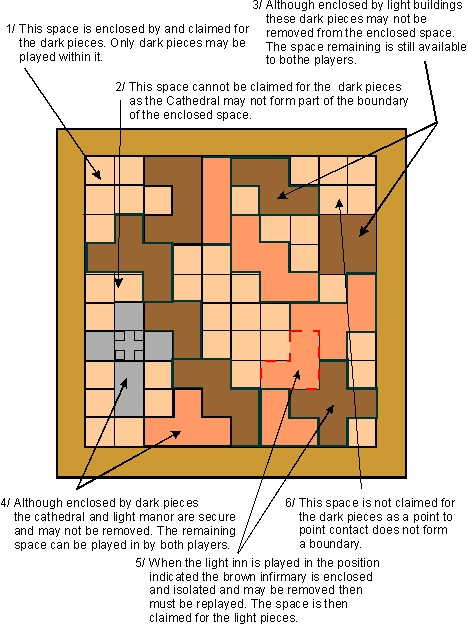
4. If you completely
enclose a part of the city with your buildings alone or with your
buildings and the wall, this part of the city becomes your property and
your opponent may not place any of his buildings within it. The buildings
must meet wall to wall, a corner to corner contact is not acceptable. Your
opponent may claim space in the same way. You may not use the Cathedral as
part of the boundary to enclose the claimed space. Neither you nor your
opponent may claim space on your first move. (See notes 1, 2 &
6)
5. If you enclose and therefore isolate one
and only one of your opponent's buildings or the Cathedral you may remove
it and claim the space enclosed. The building must be removed immediately
after the move during which it was enclosed otherwise it must remain where
it is and the space is still available to your opponent. Your opponent's
building may be replayed in a later move but the Cathedral once removed is
not replaced for the remainder of that game. If you enclose two or more
buildings. one of which may be the Cathedral, then none of the buildings
may be removed and the space is still available to your opponent (See
notes 3,4 &5)
6. The game ends when no
further moves can be made by either player.
7.
The winner is the player who succeeds in placing all his buildings within
the city while preventing his opponent from doing so. If neither player
succeeds in doing this then the player whose unplaced buildings would
occupy the least number of squares is the winner otherwise the result is a
draw.
8. When a series of games is played, the
players alternate placing the Cathedral and making the first move. At the
end of each game players are awarded points equal to the number of squares
their unplaced buildings would cover. The winner of the series is the
player with the smallest total of points.
NOTES ON THE RULES
STRATEGY
A / Concentrate on claiming space in
the early stages of the game.
B / Play your largest buildings
first.
C / Be careful not to let any of your buildings get
captured.
D / Never play your buildings into your own space while there
is still unclaimed space available.